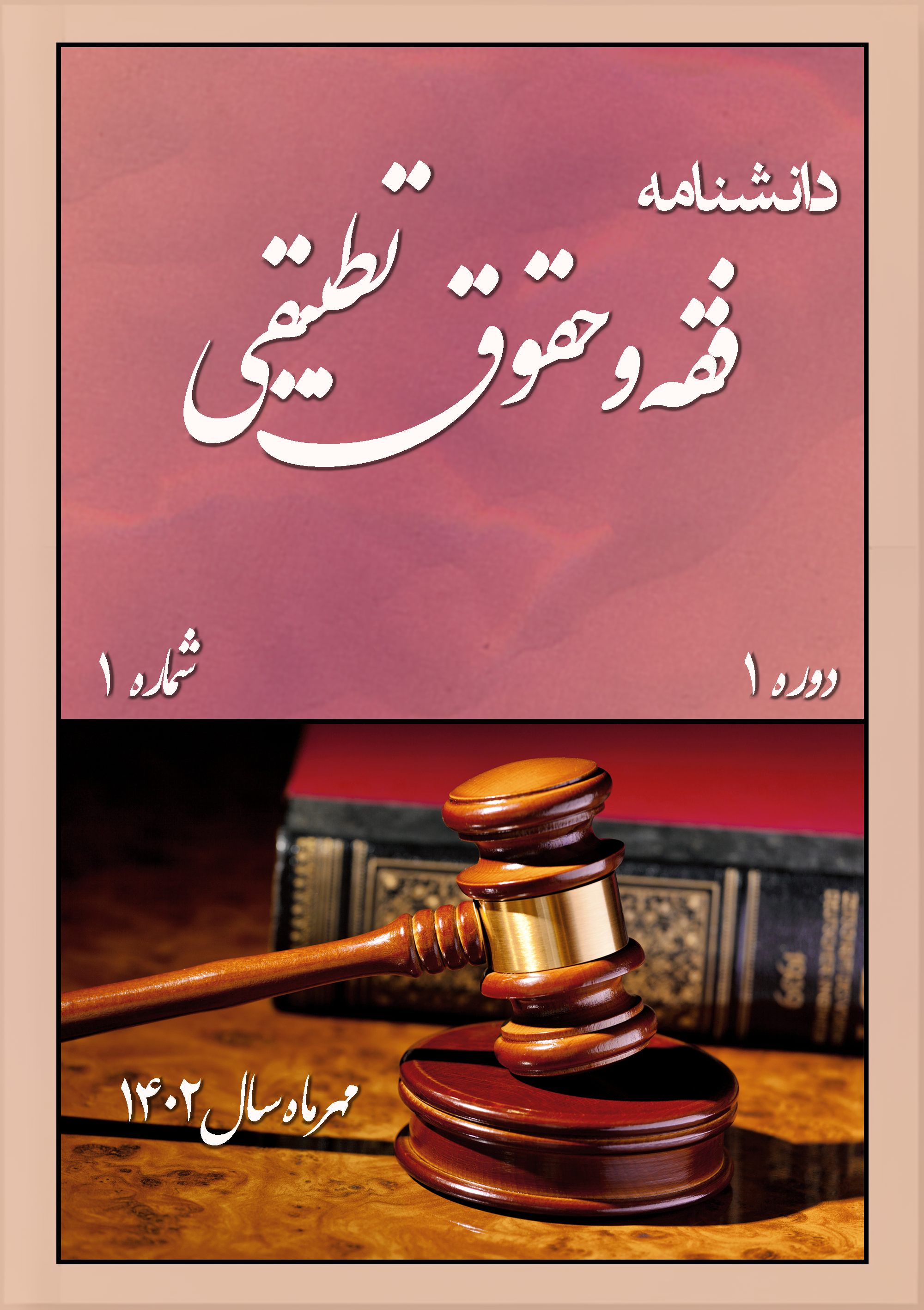
Explication and Analysis of the Distinction Between Criminal Liability Arising from Causation in Crime and Tasbib in Homicide in Islamic Jurisprudence and Statutory Law
Keywords:
criminal liability from causation, tasbib, causation in crime, tasbib in homicide, legal personsAbstract
In contemporary criminal law, various modes of involvement and influence by individuals in the commission of crimes and the realization of their criminal outcomes are defined. Among these, in offenses against bodily integrity—commonly referred to in the jurisprudential literature as jināyāt (homicide or bodily crimes)—a particular mode of contribution known as “tasbib in homicide” is emphasized. In other categories of offenses, particularly in taʿzīr crimes, another type of participation or role-playing is recognized, conventionally termed “causation (sababiyyat) in crime.” Although criminal liability arising from both modes originates from the same foundational principles—namely restitution, and the principles of equity and justice—the two diverge in scope and operative mechanisms. This divergence stems from the fact that the domain of influence in causation in crime encompasses a broader range of circumstances compared to tasbib in homicide. Additionally, in tasbib in homicide, no other human agent besides the individual ultimately held criminally liable plays a direct role in producing the harmful and criminal outcome. By contrast, in causation in crime, there is typically another human intermediary between the cause and the harmful criminal result; however, that intermediary—due to lack of independent knowledge, will, or because his or her will is overpowered—is not deemed criminally responsible. Accordingly, this article seeks to explore the multiple dimensions of the topic through an exploratory, descriptive, and analytical method, examining the distinctions between these two modes of involvement and the resulting criminal liability for both natural and legal persons, as well as their differing legal consequences. The findings aim to contribute to the scholarship of criminal law researchers and to inform future legislative developments.
Downloads
References
Abulghasemi, M. (2022). Investigating the Rule of Tasbib (Indirect Causation) in Imamiyyah Jurisprudence and Criminal Law in the Iranian Legal System. Legal Thought Journal(3), 17-31.
Askari, A. (1995). The Causal Link in Civil Liability Imam Sadiq University, Faculty of Law, Tehran].
Awdah, A. Q. (1994). Islamic Criminal Law Based on the Five Schools of Jurisprudence and its Comparison with Customary Law. Islamic Research Foundation of Astan Quds Razavi.
Bazgir, Y. (1997). Islamic Penal Code in the Mirror of Supreme Court Opinions. Qoqnoos.
Clarkson, C. (1995). Analysis of the Foundations of Criminal Law. Academic Center for Education, Culture and Research (ACECR) - Shahid Beheshti University. https://doi.org/10.1007/BF01095722
Ghomashi, S. (1998). A Comparative Study of Causation in Crime from the Viewpoint of Jurisprudence and Law Tarbiat Modares University, Faculty of Law, Tehran].
Hilli, H. i. Y. (1990). Rules of Judgments (Vol. 25). Mu'assasat al-Fiqh al-Shi'ah.
Idris, A. (1998). Blood Money. Nashr Taba' va Nashr.
Jaba'i Al-Amili, Z. D. i. A. (2008). The Ways of Understanding in Explaining the Islamic Laws. Dar al-Hadi.
Jannesar, A., & Ghahremani, N. (2022). Explaining the Civil Liability of the Indirect Cause and the Direct Perpetrator in Iranian Criminal Law with an Emphasis on the Developments of the 2013 Islamic Penal Code. Judiciary Journal, 22, 1-24.
Kazemi, M., & Ghesmati Tabrizi, A. (2023). The Method of Dividing Liability Among Perpetrators of Harm in Islamic Jurisprudence and the 2013 Islamic Penal Code. Judiciary Law Journal, 87, 281-315.
Khoshvaqt, H., & Ali Pour, H. (2022). The Causal Link in Association with the Principle of Causality in Iranian Criminal Law. Karagah Journal, 16, 171-191.
Mohseni, M. (1996). The Criminal Phenomenon. Treasure of Knowledge.
Mousavi Khomeini, S. R. (2000). Clarification of the Means (Vol. 2). Institute for Compilation and Publication of the Works of Imam Khomeini (RA).
Najafi, S. M. H. (1981). Jewels of Speech.
Noorbaha, R. (1996). Foundations of General Criminal Law. Bar Association Center.
Sadeghi, M. H. (1999). Specific Penal Law. Mizan.
Sanei, P. (1992). General Criminal Law. Treasure of Knowledge.
Seifi, A. S. (2023). A Jurisprudential and Legal Analysis of the Rules Governing the Indirect Cause being Stronger than the Direct Perpetrator with an Emphasis on Coercion in Crime. Judicial Legal Research Journal(4), 7-22.
Shambayati, H. (2023). Specific Criminal Law. Vistar.
Tabataba'i, S. A. (1992). Gardens of Issues in Explaining the Rulings of Shari'ah with Proofs (Vol. 2). The Islamic Publishing Institute Affiliated with the Society of Seminary Teachers.
Vojdani Fakhr, A., & Elahi Monshi, M. R. (2022). Causal Link in Crime and Challenges of Criminal Liability with an Outlook on the Islamic Penal Code Approved in 2013. Law and Political Studies Journal(2), 203-213.
Downloads
Publication Timeline
- Submitted
- Revised
- Accepted
Issue
Section
License
Copyright (c) 2025 احمد شیرعلی زاده; مهدی موحدی نیا (نویسنده)

This work is licensed under a Creative Commons Attribution-NonCommercial 4.0 International License.